 Flameshot
Microsoft Windows Help
Windows-specific guides
On this page you can find possible solutions for issues on Windows. This page probably needs frequent updates, so if something is outdated, please report it here.
🔗 Keyboard shortcuts
🔗 How to disable Windows Snipping tool when I press PrintScreen
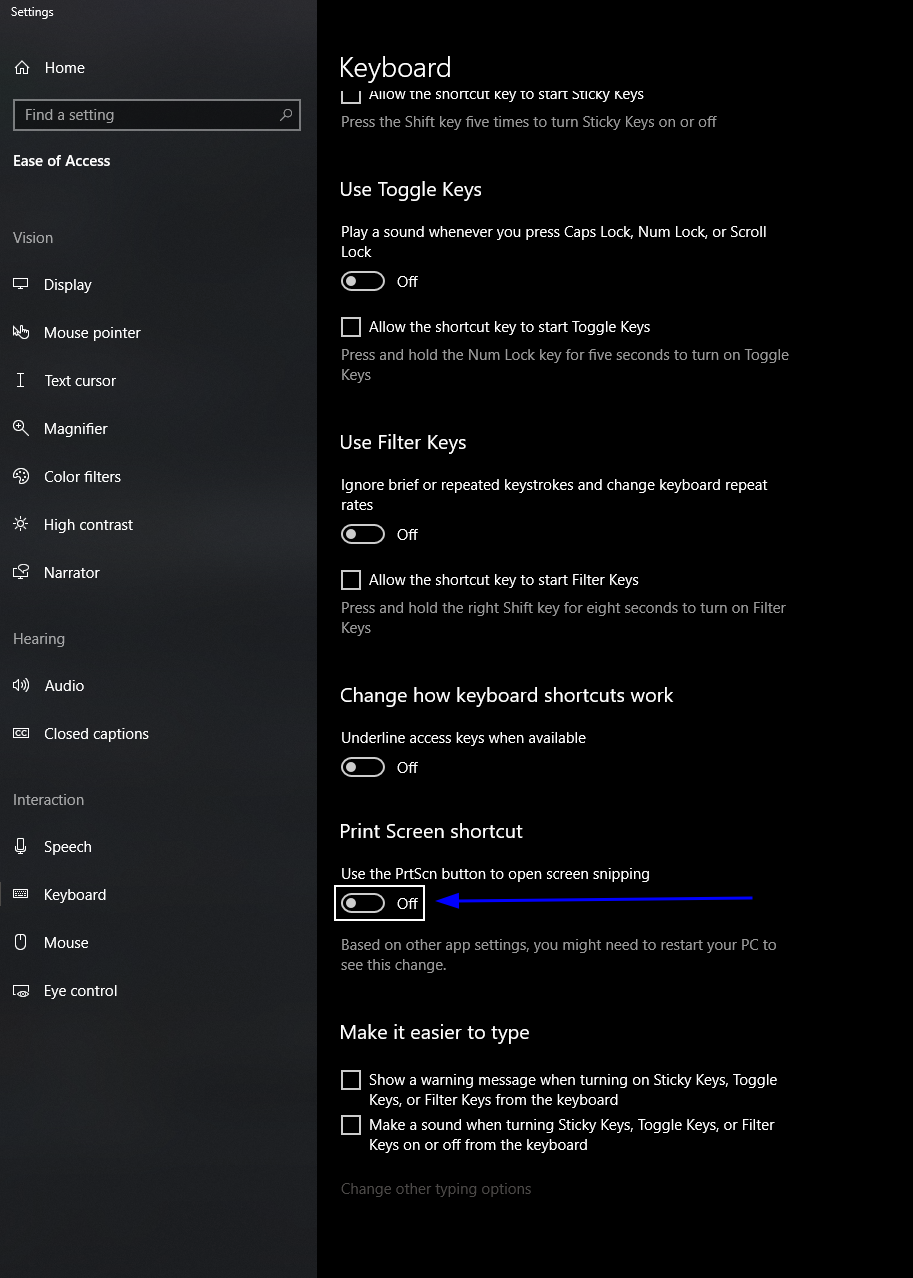
As kindly explained by one of our users, you can disable the built-in snipping tool by going to Windows Settings -> Ease of Access -> Keyboard -> Scroll down to "Print Screen Shortcut" and turn off the "Use the Prtscn button to open screen snipping":
As some of our users have reported, this does not always solve the issue, because Windows being Windows, it seems you sometimes have to take an extra step to fix this (as reported by archadallas). This has been explained in an article on makeuseof.com. If this solves your issue, please up-vote this.
🔗 Setting up custom shortcut to start Flameshot
Windows is pretty limited, but there is a way to make windows to start a program with a keybinding. To do this, you have to:
- create a shortcut file (right-click on Desktop > New > Shortcut)
- in the "Target" field, add the program you want to run (in this case the path to the
flameshot.exe) - in the "Shortcut key" field, type the keybinding you want (e.g
Ctrl + Alt + p)
For a more detailed instruction, visit this article from the Digital Citizen.
🔗 Using PowerToys
- Choose remap a shortcut
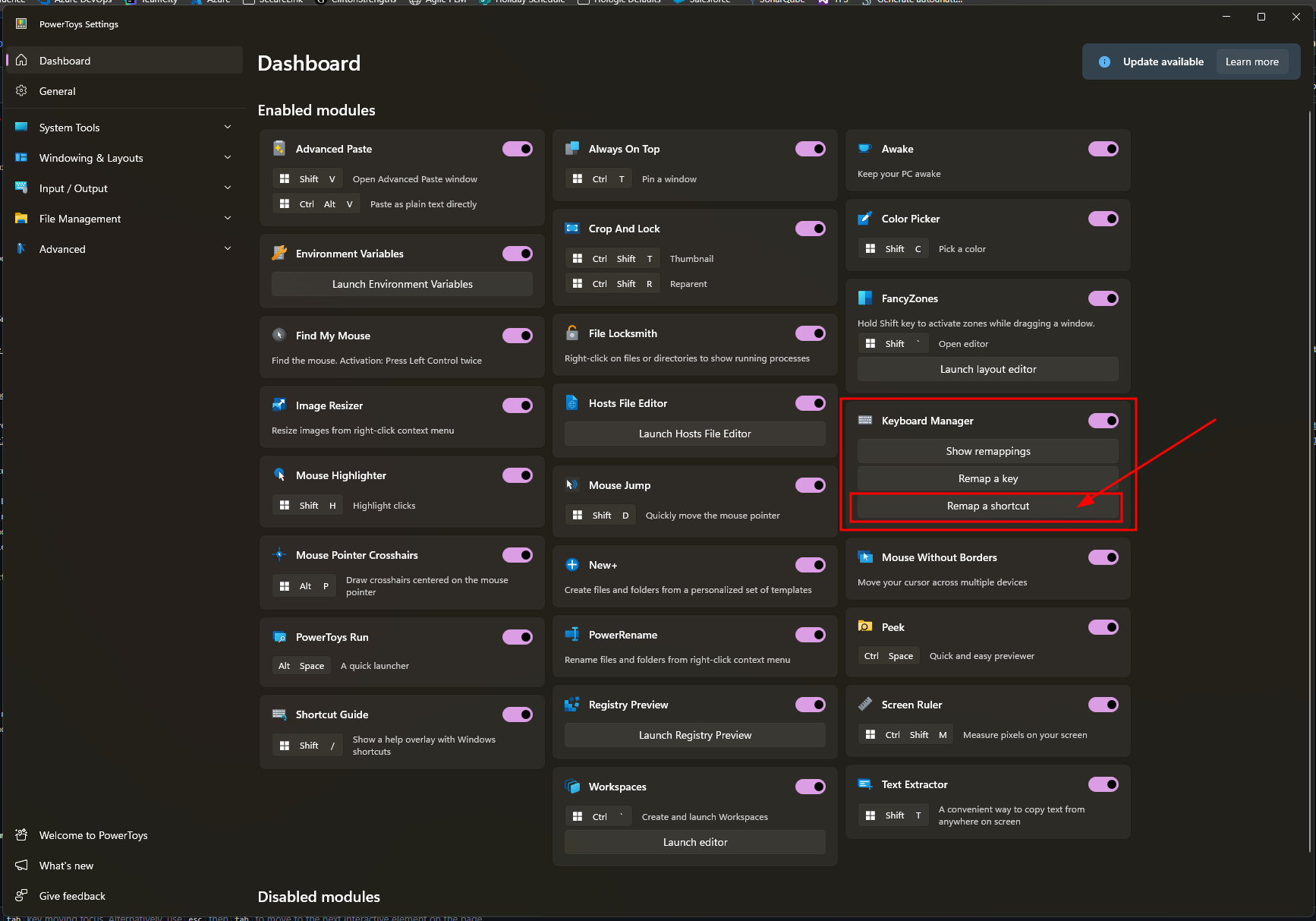
- Define your shortcut (e.g.
Ctrl + Alt + s)
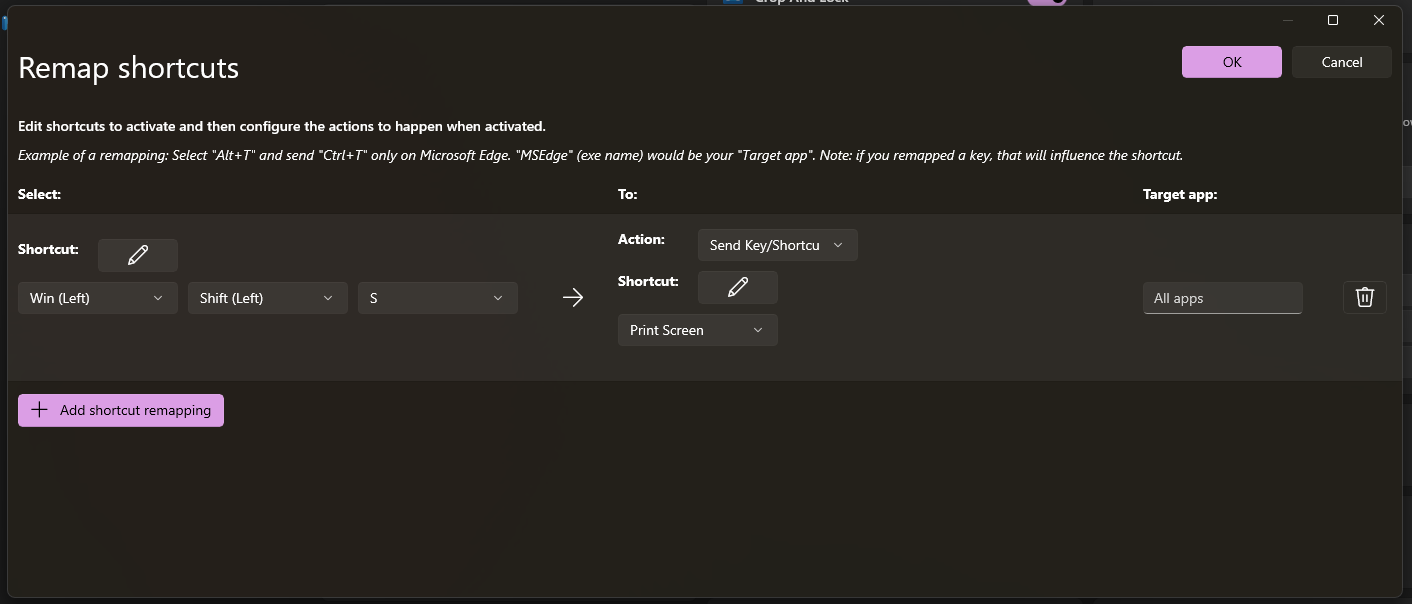
- In the Action field, Choose
Send Key/Shortcut - Choose
Print Screen - Choose OK
🔗 Overriding Windows default shortcut
Do NOT DELETE any key or modify any existing ones, you have been warned! Play around in the registry at your own risk!
If you want to override Win + Shift + S to take a screenshot using Flameshot directly instead of the default app (Snipping Tool), follow one of the two methods below.
🔗 Automatic
Put the following in a .reg file using any text editor and run it. Update Flameshot's path in the last line if you installed it elsewhere.
Windows Registry Editor Version 5.00

[HKEY_LOCAL_MACHINE\SOFTWARE\Flameshot\Capabilities\URLAssociations]
"ms-screenclip"="Flameshot"

[HKEY_LOCAL_MACHINE\SOFTWARE\RegisteredApplications]
"Flameshot"="SOFTWARE\\Flameshot\\Capabilities"

[HKEY_CLASSES_ROOT\Flameshot\Shell\Open\command]
@="\"C:\\Program Files\\Flameshot\\bin\\flameshot.exe\" gui"
Original proposal can be found on GitHub in this comment.
🔗 Manual
Note: In steps 1-5, you can replace Flameshot in the names, values, and paths with any name of your choosing as long as the change is consistently applied.
- Create this path in Windows Registry:
HKEY_LOCAL_MACHINE\SOFTWARE\Flameshot\Capabilities\URLAssociations- Create a new "String Value" there with the following data:
Name:ms-screenclip
Value:Flameshot - Go to this path:
HKEY_LOCAL_MACHINE\SOFTWARE\RegisteredApplications- Create a new "String Value" with the name
Flameshotand value:
SOFTWARE\Flameshot\Capabilities- Then create this path:
HKEY_CLASSES_ROOT\Flameshot\Shell\Open\command- Then set the default key value to where Flameshot is installed, default is:
"C:\Program Files\Flameshot\bin\flameshot.exe" gui- Change the default app by one of the following methods:
- Trigger the default hotkey Win + Shift + S and it will show you a prompt to select the default one between Snipping Tool and Flameshot, select Flameshot and choose Always.
- Manual instructions:
- Open Windows Settings app.
- Go to Default Apps.
- Scroll down to "Choose defaults by link type" and click it.
- Search for "MS-SCREENCLIP" and click on the result.
- Flameshot should come up, select it.
- Click on "Select default" button.
Reference for protocol associations can be found in the official Microsoft Documentation.